
Why 68% of Enterprise Sales Commission Plans Fail (And How to Fix Revenue Leakage in 2026
- August 10, 2026
- No Comments
Why 68% of Enterprise Sales Commission Plans Fail (And How to Fix Revenue Leakage in 2026
In today’s hyper-competitive enterprise landscape, sales compensation is no longer just an HR or Ops function—it is a core engine of revenue growth. Yet, according to industry benchmarks, nearly 68% of enterprise sales commission plans fail to meet their intended ROI, causing massive operational drag and quietly draining corporate profitability.
When commission systems misfire, the results go beyond dissatisfied reps and high turnover. They trigger revenue leakage—the systematic discrepancy between contractually obligated deal values and actual recognized, audit-compliant revenue.
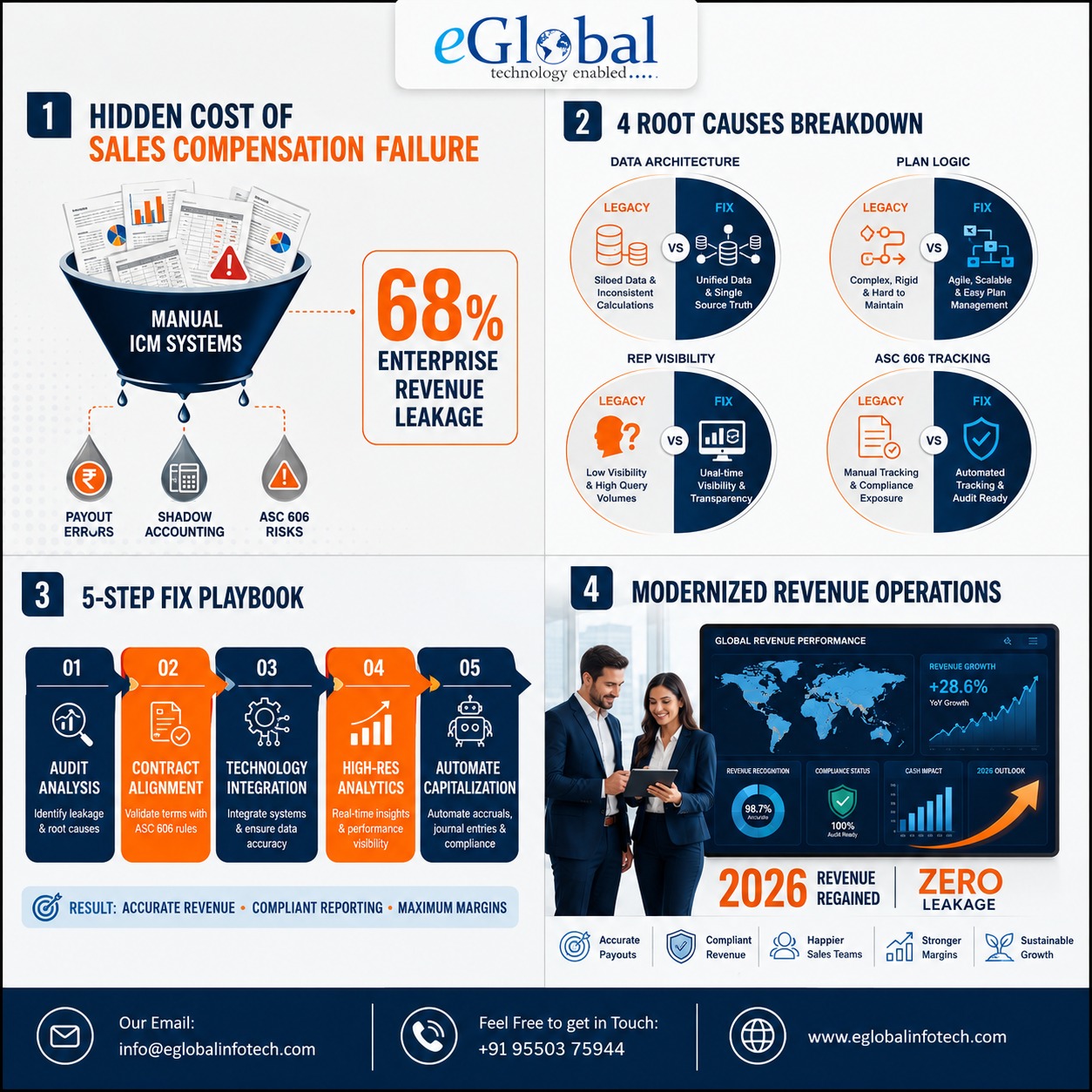
The Hidden Cost of Sales Compensation Failure For enterprise organizations managing complex multi-tier sales structures, legacy compensation administration creates a silent financial crisis.
[ Manual / Disconnected ICM Systems ]
┌────────────────┼────────────────┐
▼ ▼ ▼
Payout Errors Shadow Accounting ASC 606 Risks
└────────────────┬────────────────┘
▼
[ Enterprise Revenue Leakage ]
1. Payout Overages & Underpayments:
Manual spreadsheets and disconnected systems lead to average commission error rates between 3% and 8% of total payouts. In a $100M revenue business, this equates to millions in unrecoverable costs.
2. Shadow Accounting & Friction:
Sellers spend up to 4 to 6 hours per week tracking their own commission pay outs rather than selling—eroding trust and depressing overall sales velocity.
3. ASC 606 & IFRS 15 Compliance Gaps:
Misaligned commission capitalization rules lead to revenue restatements, audit adjustments, and valuation penalties during deal diligence or acquisition reviews.
4 Root Causes Behind Commission Plan Breakdown :
Enterprise sales motions have outgrown legacy compensation infrastructure. The root causes of plan failure usually trace back to four operational breakdowns:
eGlobal Infotech addresses critical sales compensation challenges by transforming legacy operations into modern, automated SPM solutions. Across key breakdown areas, the strategic shift delivers clear operational upgrades:
Data Syncing: Transitioning from batch processing and manual CSV uploads between CRM and ERP platforms to an automated pipeline integration enables real-time transaction ingestion.
Plan Complexity: Moving away from uncapped, rigid rules managed in massive Excel spreadsheets, eGlobal Infotech implements dynamic rule engines that seamlessly support multi-tier splits, SPIFFs, and margin criteria.
Rep Visibility: Replacing end-of-month static commission statements with real-time rep dashboards provides clear, deal-level payout modeling.
Revenue Accounting: Overcoming manual expense amortization under ASC 606 rules, modern automation establishes streamlined amortization schedules linked directly to underlying contract terms.
Disconnected Data Architecture :
When your CRM, ERP, and billing systems do not communicate seamlessly, commission rules operate on stale or conflicting deal data. Unbilled service items, custom discounts, and verbal side letters slip through the cracks, resulting in incorrect calculations.
Over-Indexing on Top-Line Volume :
Rewarding reps solely on top-line bookings—without factoring in gross margins, payment terms, or net retention—incentivizes bad deal behaviour. Reps push high-discount, low-margin contracts simply to hit quota thresholds.
Lack of Real-Time Rep Transparency :
When sellers cannot verify how a closed deal affects their paycheck in real time, productivity drops. Disputed payouts create administrative backlogs for RevOps and Finance teams every quarter.
Poor ASC 606 Amortization Tracking :
ASC 606 requires enterprise organizations to capitalize and amortize incremental costs of obtaining a contract (i.e., sales commissions) over the estimated period of benefit. Failing to track this accurately leads to material financial misstatements.
5-Step Playbook: Fixing Revenue Leakage in 2026
To stop revenue leakage and convert your incentive structures into a competitive advantage, leading enterprises are shifting to Continuous Incentive Compensation Management (ICM).
End-to-End Leakage Audit └── Map Quote-to-Cash process gaps & historical payout variances
Step 2: Align Compensation to Deal Quality
└── Tie payout accelerators to gross margin & multi-year terms
Step 3: Deploy Automated ICM Architecture
└── Integrate CRM, ERP, & billing with a dedicated ICM engine
Step 4: Enable Real-Time Rep Analytics └── Provide live payout previews & interactive deal calculators
Step 5: Automate ASC 606 Capitalization └── Link amortization schedules directly to customer lifetime values
Step 1: Conduct an End-to-End Leakage Audit Map your Quote-to-Cash lifecycle. Compare historical contracted amounts against actual billed and collected revenue over the last 12 to 24 months to quantify existing calculation errors and unbilled claims.
Step 2: Transition from Pure Revenue to Efficiency Incentives Restructure commission plans around deal profitability. Introduce accelerators tied to gross margin thresholds, multi-year contract terms, and upfront payment schedules rather than top-line volume alone.
Step 3: Integrate Your Revenue Tech Stack Eliminate manual CSV transfers. Implement an enterprise-grade Incentive Compensation Management (ICM) engine that connects directly with Salesforce, Microsoft Dynamics, SAP, or NetSuite for single-source-of-truth calculations.
Step 4: Empower Reps with Live Performance Portals Give sellers visibility into their compensation status with real-time dashboards and deal-level commission estimators. Transparency eliminates shadow accounting and builds rep trust.
Step 5: Automate ASC 606 & IFRS 15 Compliance Implement automated amortization tracking for sales commission expenses. Ensuring clear audit trails and GAAP compliance protects business valuations and simplifies year-end audits.
Modernizing Enterprise Revenue Operations Sales compensation management is no longer a yearly design task—it is an ongoing operational capability. Organizations that replace rigid manual processes with automated, continuous compensation platforms eliminate revenue leakage, restore rep focus, and safeguard operating margins.
At eGlobal Infotech, we help enterprise organizations design, implement, and optimize robust Sales Performance Management (SPM) and Incentive Compensation Management (ICM) ecosystems—ensuring every compensation dollar directly fuels profitable growth.