
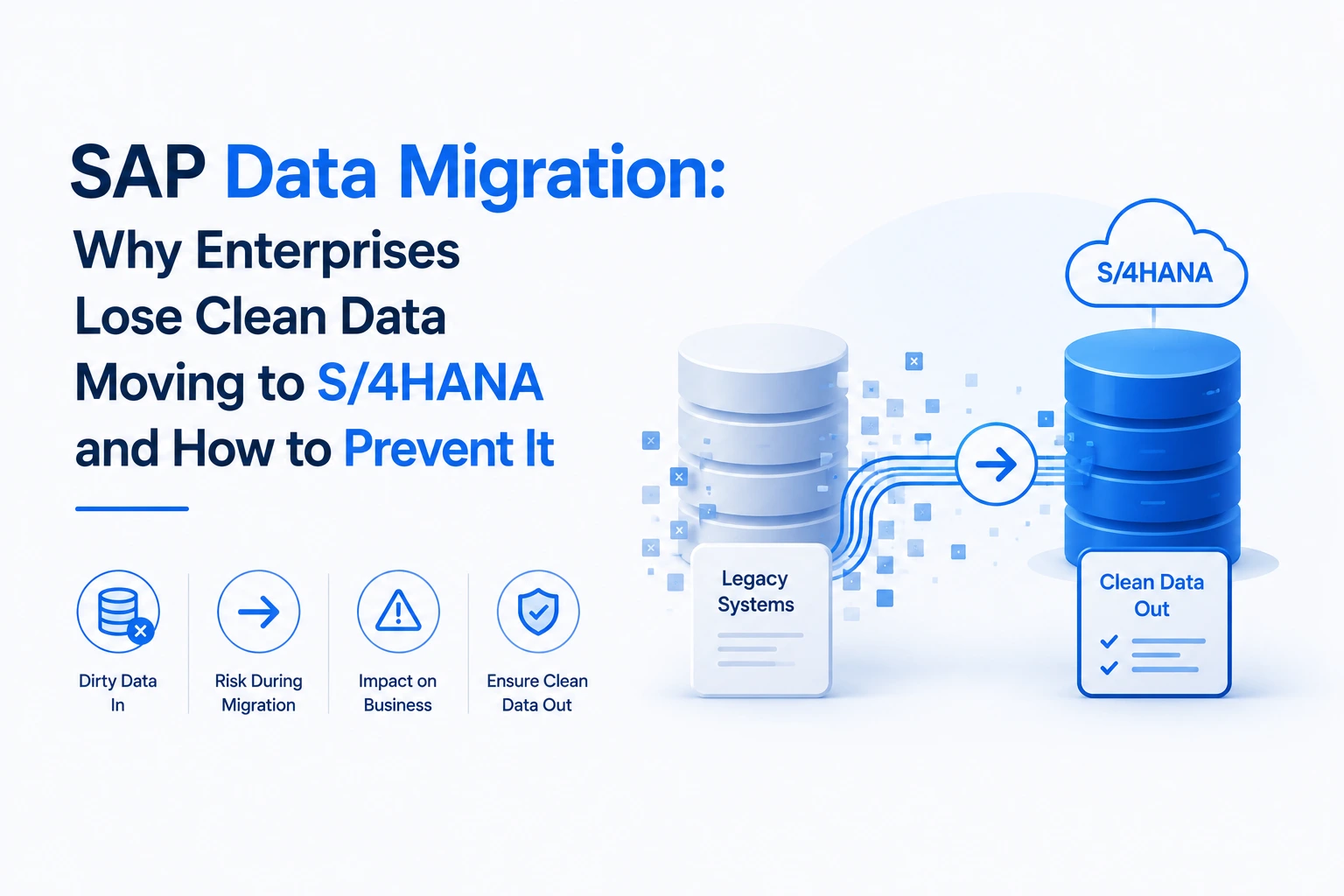
SAP Data Migration: Why Enterprises Lose Clean Data Moving to S/4HANA and How to Prevent It
- July 24, 2026
- No Comments
SAP Data Migration: Why Enterprises Lose Clean Data Moving to S/4HANA and How to Prevent It
SAP data migration to S/4HANA fails when data cleansing is deferred, transformation rules are undocumented, and reconciliation happens after go-live rather than before. Clean data migration requires a structured workstream starting in month one — not in the final weeks before cutover.
Why Is SAP Data Migration the Highest-Risk Workstream in an S/4HANA Project?
Unlike a WMS or TMS implementation where data errors affect operational efficiency, data errors in an S/4HANA migration affect financial reporting, procurement execution, and regulatory compliance simultaneously. A chart of accounts migration error does not just produce incorrect reports — it produces incorrect reports that have been signed off by finance leadership, filed with external auditors, and potentially submitted to regulatory bodies before the error is discovered.
The consequence of discovering a material data error in production is not a bug fix. It is a financial restatement exercise, a root cause investigation that finance leadership must explain to the board and auditors, and a remediation program requiring system downtime, data correction, and re-execution of financial close processes. The organizational cost of this scenario consistently exceeds the cost of the entire data migration workstream that could have prevented it.
Why Legacy SAP ECC Data Quality Is Almost Always Worse Than Teams Expect
Most organizations running SAP ECC for ten or more years have accumulated data quality problems invisible in normal operations — because standard ECC reports are built around the data as it exists, not as it should be. Duplicate vendor records created during a system migration years ago. Customer master records with incomplete address data that have never caused a visible problem because orders are entered manually. Material master records with inconsistent unit-of-measure configurations compensated for by user knowledge rather than system enforcement.
These issues become visible — and operationally significant — when data is extracted, transformed, and loaded into S/4HANA’s more constrained data model. S/4HANA’s universal journal structure requires a consistent chart of accounts and profit center hierarchy that ECC configurations often do not enforce rigorously. The mismatch between ECC’s accumulated configuration flexibility and S/4HANA’s structural requirements is where most migration data quality problems originate.
What Data Categories Does an SAP Migration Actually Cover?
Data Category | Migration Complexity | Business Impact of Errors |
Customer and vendor master | Medium | Billing disruption, procurement errors, payment failures |
Open purchase orders | High | Duplicate payments, supplier relationship damage |
Open sales orders | High | Revenue recognition errors, customer delivery failures |
Inventory balances | Very High | Operational shutdown risk, financial restatement |
Fixed assets | High | Depreciation errors, financial reporting failures |
Chart of accounts | Very High | Financial close failure, audit qualification risk |
Historical transactional data | Medium | Audit trail gaps, management reporting inaccuracy |
The highest-complexity categories — inventory balances, chart of accounts, open orders — are also where migration errors have the most immediate operational impact. These require the most rigorous pre-migration data cleansing, the most explicit transformation rule documentation, and the most thorough reconciliation validation before cutover.
What Are the Most Common SAP Data Migration Failures?
Data Cleansing Treated as a One-Time Activity
Data cleansing for an S/4HANA migration is a continuous process, not a project phase. The first cleansing cycle identifies the most visible data quality issues. Mock migration cycles reveal additional issues the initial cleansing missed. The production cutover data extract requires a final cleansing validation to confirm data quality has not degraded in the source system during the months the implementation has been running.
Master data that was clean in month two has new duplicate records by month eight as the source ECC system continues processing transactions. This is not a failure of the initial cleansing — it is a failure to maintain data quality governance throughout the project lifecycle.
Transformation Rules Documented After Configuration Rather Than Before
Data transformation rules — mapping ECC data structures to S/4HANA, converting code values, recalculating balances, handling data with no direct S/4HANA equivalent — must be documented before transformation programs are built. When documentation follows configuration, it reflects what was built rather than what was required. Errors in transformation logic are discovered through mock migration testing rather than through rule review — a slower and significantly more expensive quality control process.
Insufficient Mock Migration Cycles Before Production Cutover
A single mock migration cycle is insufficient for an enterprise S/4HANA migration. Three cycles at minimum are required: the first for technical validation confirming data can be extracted and loaded without failure; the second for business reconciliation review confirming data content is correct; and the third for cutover rehearsal — executing the full migration sequence under the time constraints of the planned production cutover window.
Reconciliation Reports That Count Records Without Validating Content
A reconciliation report confirming ‘50,000 vendor records migrated’ has zero value if it does not also confirm the migrated records are correct. Record count reconciliation is a necessary minimum but not sufficient. Content reconciliation requires comparing key field values between source and target systems for a statistically valid sample. Financial balance reconciliation requires confirming that S/4HANA account balances match ECC balances to the penny, not just directionally.
How Should an Enterprise Sequence an SAP Data Migration Workstream?
The data migration workstream must run in parallel with the broader S/4HANA implementation from month one. The five phases are:
- Phase 1 — Data Audit and Source System Inventory (Months 1–2): Extract data from all source systems and run automated data quality analysis. Identify duplicate records, incomplete mandatory fields, code value inconsistencies, and referential integrity violations. Produce a data quality report that quantifies the cleansing effort required by data category.
- Phase 2 — Data Cleansing and Governance Rules (Months 2–5): Execute the cleansing program based on the data quality report. Establish governance rules preventing new quality issues from being created in the source system during the remaining implementation period. Assign data stewardship ownership by category.
- Phase 3 — Transformation Design and ETL Build (Months 3–6): Document transformation rules for every data category, reviewed and approved by business data stewards before build begins. Build ETL programs based on approved transformation documentation. Unit test against small data sets before full-volume testing.
- Phase 4 — Mock Migration Cycles and Reconciliation (Months 6–10): Execute three mock cycles with reconciliation reporting and issue resolution between each. Issues that cannot be resolved before production cutover are documented as known risks with accepted business owners.
- Phase 5 — Production Cutover and Post-Migration Validation (Go-Live): Execute the final migration using the process validated in mock cycle three. Confirm all reconciliation checkpoints pass before business operations begin on S/4HANA.
What Tools Are Used for SAP Data Migration?
SAP Migration Cockpit handles standard master data and selected transaction data migration using SAP-provided templates. It is the right tool for organizations with standard SAP data configurations and manageable data volumes. It covers common objects — customers, vendors, materials, open orders — without custom development.
SAP BODS (Business Object Data Services) is appropriate for complex transformation scenarios: large data volumes, non-standard object types, transformations requiring business logic beyond what Migration Cockpit supports, and historical data migration. BODS requires more implementation effort but provides the flexibility complex enterprise migrations require.
Neither tool substitutes for migration governance. eGlobal Infotech’s data analytics and integration services include migration governance as a structured workstream alongside technical ETL development — because a technically sound migration executed without documented transformation rules and rigorous reconciliation will produce data quality problems in production regardless of the tooling used.
Frequently Asked Questions
Data migration as a workstream runs six to twelve months in parallel with the broader implementation. It must begin in month one — organizations that treat it as a late-phase activity consistently experience go-live delays or post-go-live data quality incidents.
Migration moves active data to the new system. Archiving moves historical data to lower-cost storage that remains accessible but outside the live system. Both decisions must be made before migration scope is finalized — archiving decisions affect which categories require full migration.
A minimum of three. Cycle one validates technical extraction and load. Cycle two validates business reconciliation and content accuracy. Cycle three rehearses the production cutover sequence under time pressure. One cycle is insufficient regardless of how well it goes.
Technically possible, not advisable. Migrating without cleansing transfers existing data quality problems into S/4HANA's more constrained data model, where they are harder to identify and significantly more expensive to correct than they would have been in the source system.
SAP Migration Cockpit handles standard master data migration using predefined templates. It does not handle complex transformation logic, large historical data volumes, or custom object types — those require BODS or custom ETL development.
eGlobal Infotech’s SAP data migration specialists have delivered S/4HANA migration workstreams across finance, supply chain, and sales operations environments. Contact us at info@eglobalinfotech.com for a migration readiness assessment.