
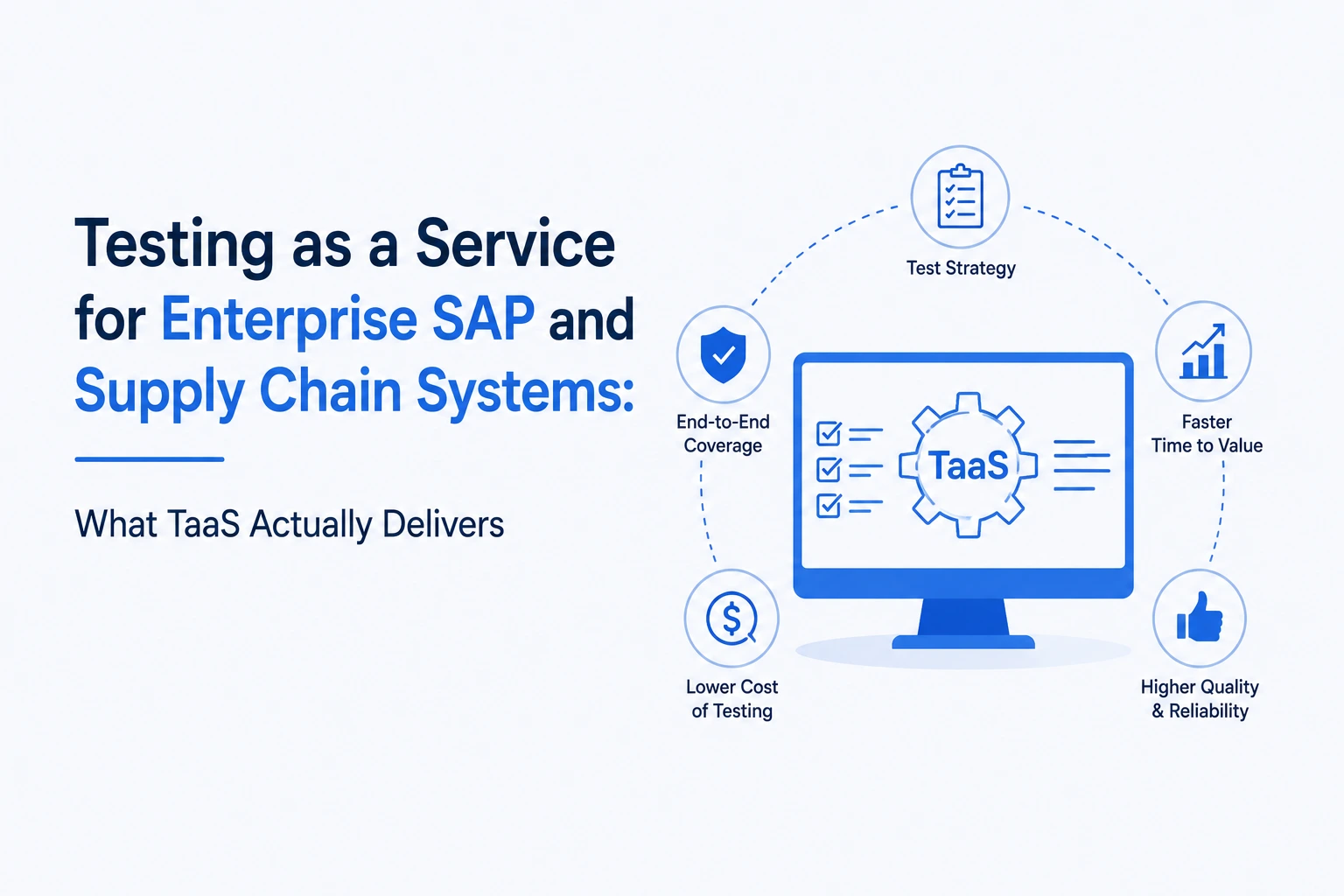
Testing as a Service for Enterprise SAP and Supply Chain Systems: What TaaS Actually Delivers
Testing as a Service Enterprise SAP and Supply Chain Systems: What TaaS Actually Delivers
Testing as a service enterprise SAP provides independent, structured QA execution without a permanent internal testing team. The ROI case is direct: defects found in production cost 10 to 100 times more to fix than defects caught during testing — and in SAP Commissions or WMS environments, production defects affect real payouts and real operations.
Why Do Enterprise SAP and Supply Chain Projects Need Independent Testing?
The Conflict of Interest When Implementation Teams Test Their Own Configuration
A consultant who built a compensation plan rule in SAP Commissions has a mental model of how that rule works. When testing it, they test the scenarios they know — and avoid scenarios they have not considered, often without realizing it. The edge cases that eventually surface in production are precisely the scenarios that fell outside the implementation team’s mental model.
Independent testing breaks this pattern. A QA team that did not build the configuration approaches testing from the user’s perspective — what should happen according to business requirements — rather than the builder’s perspective of what the configuration was designed to do. The difference in test coverage is substantial and consistently produces fewer production defects.
Why Internal Business Users Cannot Fully Cover UAT Scope
Business superusers who conduct UAT understand their processes deeply, but they are not professional testers. They test the workflows they use most frequently and skip exception paths, integration scenarios, and edge cases they rarely encounter in day-to-day operations. Month-end commission disputes, year-end plan exceptions, and multi-currency calculation edge cases go untested and surface as production defects in the months following go-live.
What Happens When Testing Gets Compressed
When an SAP implementation runs behind schedule, testing absorbs the pressure. The organizational drive to avoid a go-live delay wins, testing gets compressed, and the project goes live with documented test coverage that looks adequate but is not. The false assurance of completed testing is more dangerous than acknowledged incomplete testing, because it removes organizational pressure to address known gaps before go-live.
What Does Testing as a Service Actually Include for Enterprise SAP Environments?
TaaS for enterprise SAP covers the full testing lifecycle from strategy through go-live readiness certification. The scope includes:
- Test strategy and test plan development: which testing types are required, what the acceptance criteria are for each, how defects will be classified and managed, and what go-live readiness criteria look like
- Test case design: for SAP Commissions, SPM, WMS, and TMS environments — covering standard scenarios, edge cases, exception handling, and end-to-end integration scenarios
- Test execution: manual for complex business scenarios, scripted for repetitive high-volume scenarios, and automation-assisted for regression testing
- Defect management and reporting: every defect documented with severity classification, reproduction steps, and assigned ownership — providing the steering committee with real-time testing status
Go-live readiness certification: a formal statement confirming test coverage was adequate and outstanding defects are below the agreed acceptable threshold
What SAP Modules and Supply Chain Systems Benefit Most from TaaS?
|
System |
High-Risk Testing Areas |
TaaS Value |
|
SAP Commissions |
Calculation accuracy, crediting edge cases, parallel run validation |
Eliminates payout errors at go-live |
|
SAP SPM |
Quota attainment logic, territory hierarchy, reporting accuracy |
Validates business rule integrity |
|
Blue Yonder WMS |
Receiving, pick/pack, inventory accuracy, ERP integration |
Catches integration gaps before production |
|
Blue Yonder TMS |
Rate calculation, carrier tender, EDI validation, freight audit |
Prevents freight billing errors from day one |
|
SAP S/4HANA |
Finance close, procurement, order management, reporting |
Reduces business disruption at go-live |
How Is Enterprise TaaS Different from Hiring a QA Contractor?
A QA contractor brings individual testing execution capacity. TaaS brings testing methodology, test management governance, domain-specific test case libraries, and traceability between business requirements, test cases, and defects. This traceability is what makes a go-live readiness certification meaningful rather than cosmetic.
For SAP Commissions implementation projects specifically, TaaS traceability means every compensation plan rule has a corresponding test case, every test case has an execution result, and every defect is linked back to the rule it exposed. When a commission dispute arises in month two of production, that audit trail is the fastest path to root cause resolution.
What Does TaaS Scope Look Like for a Typical SAP Commissions Go-Live?
For a mid-complexity SAP Commissions implementation with 10 to 20 active compensation plans and 500 to 1,500 payees, a TaaS engagement typically includes:
- Requirements-to-test-case mapping covering all plan rules and crediting logic
- 300 to 500 test cases covering standard scenarios, edge cases, and integration scenarios
- Parallel calculation validation comparing SAP Commissions outputs against the legacy calculation process for two to three historical periods
- CRM integration testing validating that deal data flows correctly from Salesforce or SAP CRM into the calculation engine
- ERP integration testing validating that payroll-ready commission outputs flow correctly to the payroll system
- UAT facilitation for compensation analysts and sales operations stakeholders
Go-live readiness certification documenting test coverage and outstanding risk items
What Are the Most Common Testing Failures in Enterprise SAP Projects?
Testing scope defined by what is easy to test rather than what is highest risk is the most expensive failure pattern. Easy-to-test scenarios are the ones the implementation team understands well. Highest-risk scenarios involve complex business rules, system integrations, or data conditions the implementation team has not fully modeled. A test plan that maximizes standard scenario coverage while minimizing complex scenario coverage provides false assurance at exactly the wrong moment.
The second most common failure is having no regression testing plan for post-go-live. Configuration changes happen continuously after go-live — new compensation plans, updated crediting rules, quarterly rate table updates. Each change carries the risk of unintended side effects on existing functionality. Without regression testing, these side effects accumulate until they produce a significant production incident that could have been caught in a development environment.
Frequently Asked Questions
When in an SAP implementation should TaaS engagement begin?
During the design phase. Test case development needs to happen alongside configuration, not after it completes. Engaging TaaS at the UAT stage means test cases are written against a completed system with no time to address coverage gaps.
Can TaaS cover regression testing after go-live?
Yes, and this is where ongoing TaaS relationships deliver the most sustained value. Quarterly plan changes, annual compensation redesigns, and system upgrades all require regression testing before changes reach production.
How many test cases does a typical SAP Commissions go-live require?
Between 200 and 800 depending on compensation plan count, crediting rule complexity, and integration scope. Multi-country plans and multi-product crediting environments consistently require the upper end of that range.
Does TaaS require access to production data?
No. TaaS uses de-identified or synthetic test data sets that reflect production scenarios without exposing live employee or customer data. Data privacy protocols are defined during engagement setup.
What is the cost of not having independent testing on an SAP go-live?
Post-go-live defects in SAP Commissions or WMS environments cost 10 to 100 times more to resolve than pre-go-live defects — plus the operational and morale impact of incorrect payouts or inventory errors from day one.
eGlobal Infotech’s TaaS practice delivers independent testing for SAP Commissions, Blue Yonder WMS/TMS, and enterprise SAP go-lives. Contact us at info@eglobalinfotech.com to scope your testing requirements.