
Veeva Vault Implementation for Life Sciences: What Pharma IT Teams Need to Get Right
- July 22, 2026
- No Comments
Veeva Vault Implementation for Life Sciences: What Pharma IT Teams Need to Get Right
Veeva Vault implementation fails most often at three points: content migration without a metadata governance framework, 21 CFR Part 11 compliance gaps in electronic signature configuration, and SAP integration scoped too late. All three are preventable if treated as first-phase decisions rather than late-project activities.
What Veeva Vault Covers Across the Pharma Content Lifecycle
Veeva Vault is a multi-module platform. Understanding which modules are in scope is the first decision pharma IT teams need to make before implementation begins — because module selection determines validation scope, integration requirements, and project timeline.
The three most commonly implemented modules are Vault QualityDocs, which manages SOPs, batch records, deviation reports, and CAPAs for GxP-regulated quality operations; Vault RegulatoryDocs, which manages CTD documents, labeling, and regulatory correspondence for submission programs; and Vault PromoMats, which manages promotional and medical affairs content through multi-stakeholder review and approval workflows. Organizations implementing Veeva Vault for the first time typically start with QualityDocs and expand to additional modules in subsequent phases.
How Veeva Vault Differs from SharePoint in Regulated Environments
The differences are structural, not feature-level. Veeva Vault has a built-in audit trail capturing every document action — view, edit, approval, rejection, signature — at the system level without configuration. SharePoint’s version history captures document changes but does not provide the complete user action audit trail that FDA 21 CFR Part 11 and EU Annex 11 require.
Veeva Vault’s electronic signature implementation is 21 CFR Part 11 compliant by design — the signature is bound to the document record, signer identity is verified, and the signature event is captured in the audit trail. Making SharePoint meet the same standard requires third-party add-ins and a validation effort that typically exceeds the cost of implementing Vault directly.
What Makes Veeva Vault Implementation Different from Standard Cloud Projects?
Computer System Validation Cannot Be Treated as a Post-Go-Live Activity
Computer System Validation for a Veeva Vault implementation requires Installation Qualification (IQ) confirming the system is installed as specified, Operational Qualification (OQ) confirming the system operates as designed, and Performance Qualification (PQ) confirming the system performs correctly in the intended use context. Each requires a documented protocol, executed testing, and a signed completion report.
Treating CSV as a post-go-live documentation exercise produces validation reports that do not reflect how the system was actually configured and tested. This creates audit exposure that cannot be retroactively corrected without re-executing the validation protocols — which means a system that went live without proper CSV documentation may need to be taken offline for re-validation if an FDA inspector requests validation evidence.
21 CFR Part 11 Compliance Gaps in Electronic Signature Configuration
Vault’s electronic signature configuration decisions — which events trigger a signature requirement, which signature meaning statements are presented to users, how signature events are reported — need to be made deliberately and documented explicitly. The most common compliance gap is electronic signature configuration that satisfies the 21 CFR Part 11 definition technically but does not match the organization’s actual document approval authority matrix. This gap is invisible until an FDA inspector reviews audit trail records and finds signatures from personnel who were not authorized to approve that document type.
What Are the Most Frequent Veeva Vault Implementation Failures?
Content Migration Without a Document Classification and Metadata Governance Framework
Content migration into Vault is not a file transfer — it is a document classification and metadata assignment exercise. Every migrated document needs to be assigned to the correct document type, lifecycle, and classification within the Vault taxonomy. Documents migrated without correct classification end up in wrong lifecycle states with incorrect access permissions. The migration scope decision — which documents migrate into Vault, which get archived, which are retired — is a business and quality decision that must be made before migration begins, not during it.
User Role and Permission Design That Creates Compliance Gaps
The temptation in most implementations is to assign broad permissions to avoid friction. The compliance consequence of over-permissioning is that users can access and act on documents outside their authorized scope — creating audit trail records that do not align with the organization’s quality process.
Role design must start from the existing authority matrix: who is authorized to initiate, review, approve, and archive which document types. This translation from policy to Vault permission groups takes longer than most implementation timelines budget for, which is why it should begin in the design phase.
SAP Integration Scoped Too Late
Organizations running SAP ERP alongside Veeva Vault need integration for quality event management, regulatory submission tracking, and batch record management. eGlobal Infotech’s life sciences and pharma IT services consistently include SAP-Veeva integration as a first-phase design activity, not a discovery after UAT begins. Discovering the integration requirement during testing means building and validating it against an impossible timeline.
How Should Pharma IT Teams Structure a Veeva Vault Implementation?
Phase | Key Activities | Compliance Gate |
Discovery | Requirements, module selection, gap analysis, system impact assessment | Validation plan approval |
Design and configuration | Lifecycle design, role/permission matrix, workflow build, taxonomy design | Design qualification (DQ) |
Testing | IQ, OQ, PQ protocol execution, defect resolution | Validation protocol completion |
Migration | Document classification, metadata mapping, migration testing | Migration validation report |
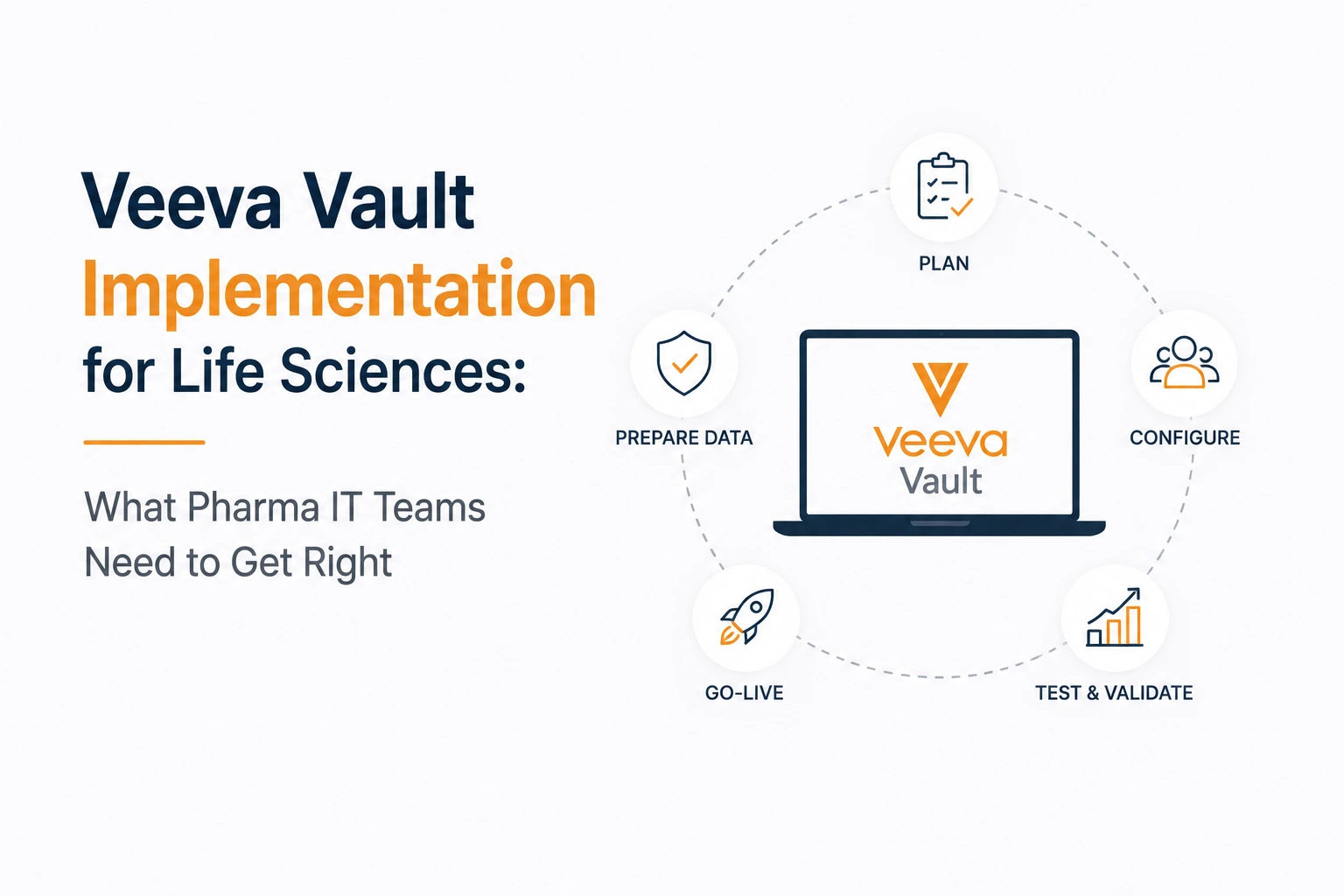
Go-live | User training, cutover, hypercare, validation closure report | System validation closure |
What Does Veeva Vault Managed Support Look Like After Implementation?
Veeva Vault in a regulated environment cannot be managed informally after go-live. Every configuration change — adding a document type, modifying a lifecycle state, changing a permission group — requires change control: documented, impact-assessed against the validation baseline, tested, and deployed through a formal process before reaching production.
Organizations that manage Vault through informal IT requests consistently find their validation status degrading as undocumented configuration changes accumulate. A managed services arrangement that includes configuration change management and periodic revalidation support maintains validation status and reduces the risk of audit findings related to system management.
Frequently Asked Questions
Six to twelve months depending on which Vault modules are in scope, content migration volume, and CSV documentation requirements. QualityDocs implementations run at the shorter end; RegulatoryDocs implementations with complex migration typically run longer.
Yes for any Vault used in GxP-regulated activities. IQ, OQ, and PQ protocol documentation is a regulatory requirement, not an optional quality activity. Post-go-live CSV cannot retroactively substitute for pre-go-live validation.
For GxP-regulated documents, yes. SharePoint lacks the audit trail depth, electronic signature controls, and lifecycle management required for 21 CFR Part 11 compliance. The effort to make SharePoint compliant typically exceeds the cost of implementing Vault correctly.
PromoMats manages commercial and promotional content approval workflows for medical and legal review. QualityDocs manages SOPs, batch records, and quality system documentation for GxP compliance. Both run on the Vault platform but serve distinct regulatory functions.
Working with consultants who have hands-on Vault configuration and CSV execution experience significantly reduces implementation risk. Veeva implementations in regulated environments are not suitable for general-purpose IT consultants without life sciences domain expertise.
eGlobal Infotech’s life sciences team delivers Veeva Vault implementations with built-in CSV documentation, compliance configuration, and SAP integration expertise. Contact us at info@eglobalinfotech.com to discuss your Vault project.