
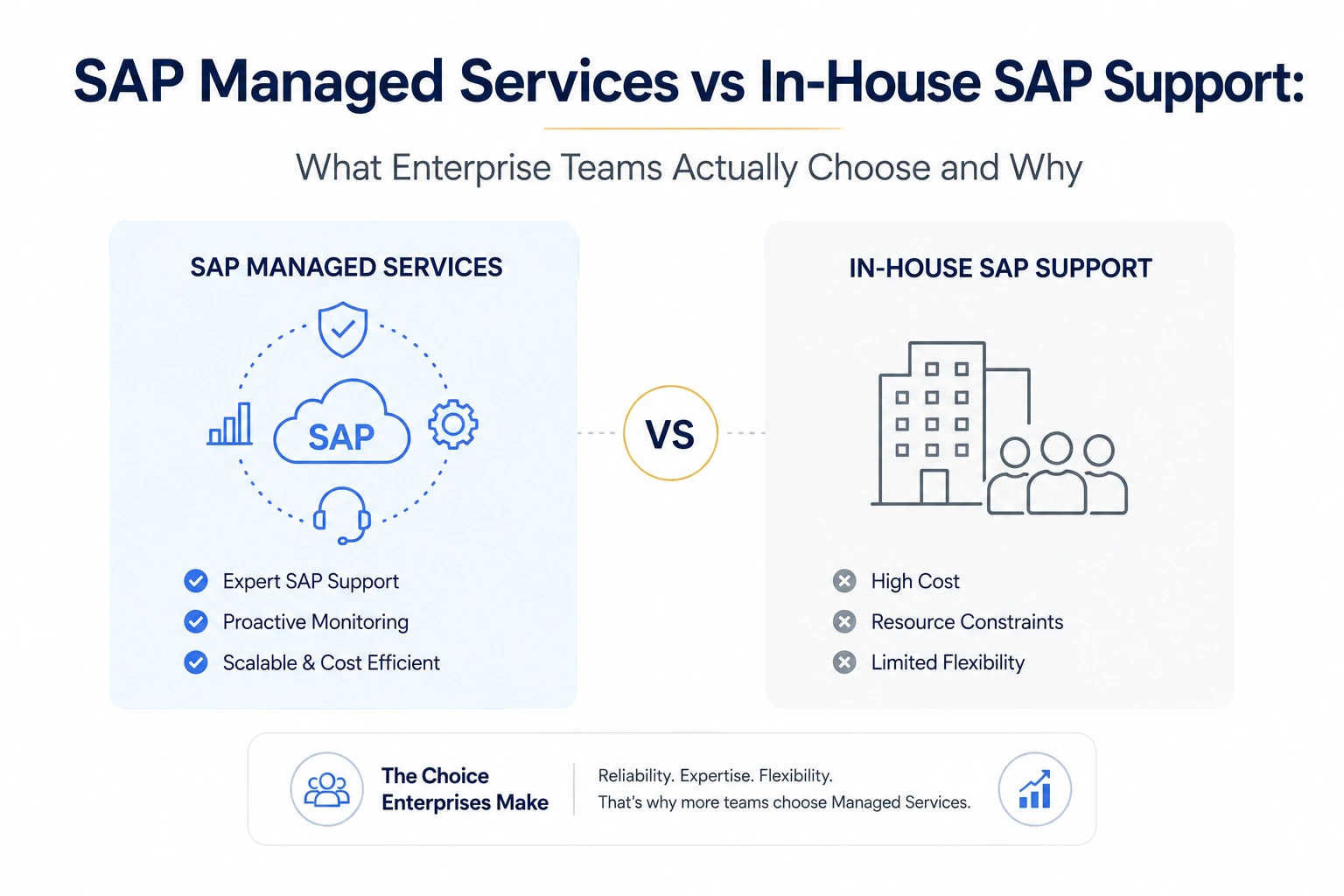
SAP Managed Services vs In-House SAP Support: What Enterprise Teams Actually Choose and Why
- July 22, 2026
- No Comments
SAP Managed Services vs In-House SAP Support: What Enterprise Teams Actually Choose and Why
SAP managed services reduce support costs by 25 to 40 percent while improving incident resolution speed and release coverage. The decision hinges on three factors: internal SAP expertise depth across the modules you run, upgrade frequency, and your real three-year total cost of ownership.
Why Are Enterprises Reconsidering Their SAP Support Model After Go-Live?
The transition from implementation to steady-state support is the moment most organizations discover their internal support model is weaker than they believed. During implementation, the partner team handles complex configuration issues, integration problems, and performance troubleshooting. When that team rolls off, the internal team inherits a system they understand operationally but may not understand at the configuration level.
The second driver is SAP’s accelerating product evolution. S/4HANA release cycles, SAP Sales Cloud updates, and SAP Commissions quarterly releases all require someone to evaluate the impact of changes on existing configuration, test the environment before updates are applied, and manage deployment to production. When organizations try to manage quarterly release cycles with internal teams that have primary jobs in finance or sales operations, release management gets deprioritized. Environments fall multiple releases behind, accumulating technical debt that eventually requires a dedicated catch-up project.
The Hidden Cost of Maintaining In-House SAP Expertise
Most organizations undercount the true cost of in-house SAP support. Salary and benefits are visible. The cost of attrition — when a senior SAP Commissions consultant or WMS specialist leaves and takes months of institutional knowledge — is less visible until it happens. The cost of not having on-call coverage when a payroll close fails at 11pm on a Friday is invisible until it does.
An enterprise running SAP Commissions, SAP SPM, Blue Yonder WMS, and SAP ERP needs specialist expertise across at least four module areas. Finding individuals with deep expertise in more than two of those areas is difficult, and the talent market reflects that scarcity. Building and retaining that bench internally costs more than most IT budgets account for.
What Does SAP Managed Services Actually Cover?
SAP managed services — more precisely, Application Management Services (AMS) — covers ongoing support and enhancement of SAP applications. The core scope includes:
- Incident management: when something breaks in SAP Commissions or Blue Yonder WMS, the managed services team investigates, resolves within the contracted SLA, and documents the fix
- Enhancement support: configuration changes requested by the business — new compensation plan rules, new reports, workflow modifications — that fall outside break-fix scope
- Release management: evaluating the impact of SAP platform updates, testing in non-production environments, and deploying to production through a governed change process
- Proactive monitoring: identifying performance degradation, data quality issues, and configuration drift before they become production incidents
What managed services does not cover: major new module implementations, large-scale data migrations, business transformation programs, and issues caused by changes made outside the managed services change process. Scope clarity before contract signature prevents disputes during the engagement.
SAP Managed Services vs In-House Support — Direct Comparison
Factor | SAP Managed Services | In-House Team |
Cost model | Predictable monthly fee | Variable — salary, benefits, training, attrition cost |
Expertise breadth | Multi-module specialist bench | Typically 2–4 module specialists |
Availability | 24/7 coverage standard | Business hours unless on-call is explicitly structured |
Release management | Included and scheduled | Requires internal resourcing and coordination |
Scalability | Adjustable by contract scope | Headcount and hiring dependent |
Knowledge continuity | Governed by managed services partner | At risk from attrition and role changes |
When Does Keeping SAP Support In-House Make Sense?
In-house SAP support works when three conditions are met simultaneously: the organization has built genuine depth across the modules it runs, the internal team has been stable for multiple years with low attrition, and the SAP environment is relatively static — not absorbing frequent plan changes, new module deployments, or regular business process evolution.
It also makes sense where regulatory or data sovereignty requirements restrict external access, or where the SAP configuration is so heavily customized that transferring institutional knowledge to an external team is genuinely difficult. For most mid-size and large enterprises, these conditions are not all present at the same time.
What Should Enterprises Include in an SAP Managed Services Contract?
Four elements determine whether an SAP managed services contract delivers what the organization needs or becomes a source of ongoing disputes:
- SLA tiers: P1 critical issues (system down, payroll failure) should have a one to two hour response and four to eight hour resolution target. P2 major issues: four hour response. P3 and P4: next business day. These tiers are negotiable and must be confirmed explicitly before signature.
- Enhancement request process: how configuration changes are submitted, sized, prioritized, and deployed through development, testing, and production. An informal change process is a reliable source of production incidents.
- Knowledge transfer and documentation obligations: minimum documentation requirements covering configuration, runbooks for common support scenarios, and system landscape diagrams. This documentation determines whether transition back to internal support or to a different partner is possible.
Exit provisions: what happens at contract end, how transition is managed, and what data and documentation the organization retains. Exit provisions are most important when least expected to matter — which means they need to be negotiated before the contract starts.
How Modern SPM Services Solve Sales Performance Challenges
Modern SPM solutions replace manual processes with automated workflows, centralized data management, and real-time analytics.
Business Challenge | SPM Solution |
Manual commission calculations | Automated incentive compensation management |
Limited earnings visibility | Real-time performance dashboards |
Inconsistent territory assignments | Data-driven territory planning |
Forecasting uncertainty | Advanced analytics and forecasting |
Disconnected operational systems | Integrated sales performance ecosystem |
This structured approach enables organizations to improve efficiency while maintaining greater control over performance management processes.
How Do Enterprises Transition from In-House to Managed Services?
A structured transition takes eight to twelve weeks. The first four weeks cover knowledge transfer — the managed services team shadows the internal team, reviews existing documentation, and maps the support landscape. The next four weeks run parallel support, with the managed services team handling incidents and the internal team in oversight mode. The final phase is full handover with the internal team moving to a governance role.
Organizations that rush this transition — moving directly from internal support to managed services without structured handover — consistently experience elevated incident rates in the first sixty days. This is avoidable with the right transition plan. eGlobal Infotech’s SAP consulting services include structured transition management as part of every managed services engagement.
Frequently Asked Questions
Costs vary by module coverage, incident volume, and SLA tier. Most mid-size enterprises pay between $15,000 and $60,000 per month for full AMS across two to four SAP modules. Get a detailed proposal based on your specific environment.
Yes. Specialist SAP managed services providers offer module-specific support for SAP Commissions, SPM, and ICM — including plan configuration changes, calculation issue resolution, and period-end support. Confirm module-specific expertise before engagement.
Eight to twelve weeks covering knowledge transfer, shadowing, parallel support, and full handover. Rushing this transition is the most common cause of elevated incident rates in the first months of a managed services engagement.
P1 critical: one to two hour response, four to eight hour resolution target. P2 major: four hour response. P3 and P4: next business day. These are negotiable — confirm them explicitly before contract signature.
Not exactly. Managed services covers ongoing application support and enhancement within a defined scope. Most SAP managed services contracts are application-layer only — the organization retains ownership and governance of the system.
eGlobal Infotech provides SAP managed services across SAP Commissions, SPM, ICM, and supply chain platforms. Contact us at info@eglobalinfotech.com to review your support model and get a managed services assessment. |