
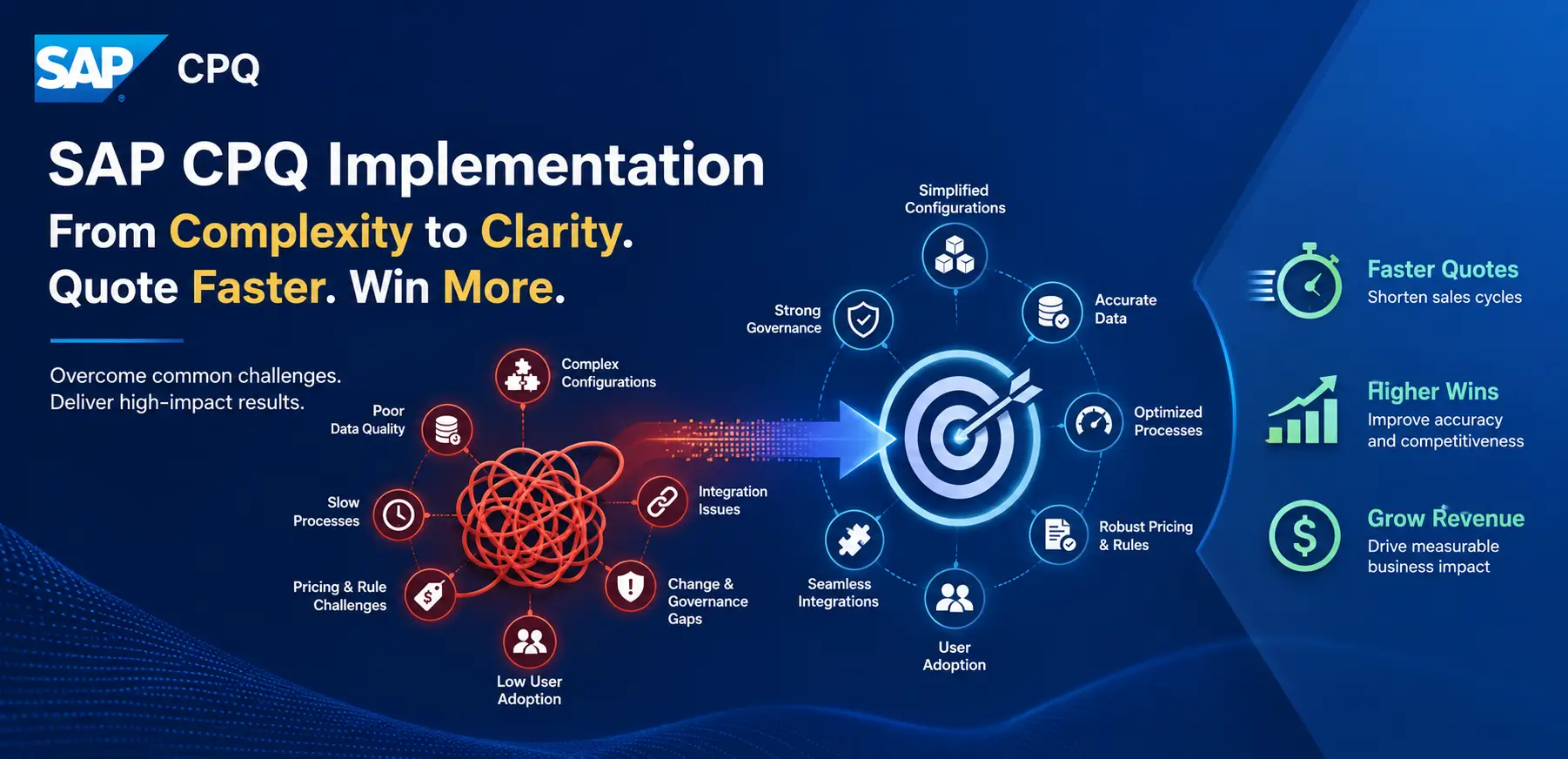
SAP CPQ Implementation Why Configuration to Quote Projects Fail and How to Fix Them
- July 20, 2026
- No Comments
SAP CPQ Implementation Why Configuration to Quote Projects Fail and How to Fix Them
SAP CPQ implementation failures trace back to three root causes: unstructured product catalogs, pricing rules that were never formally documented, and CRM integration treated as a late-phase task. Here is the implementation architecture that prevents each of them.
What Makes SAP CPQ Implementation More Complex Than Standard SAP Projects?
SAP Configure Price Quote operates at the intersection of sales, finance, and product engineering data. Sales teams configure products and generate quotes. Finance owns pricing rules and margin thresholds. Engineering or product management defines what configurations are technically valid. Implementing a system that enforces alignment across three functions — each with different data languages and different priorities — is a governance challenge as much as a technical one.
The second complexity layer is the product catalog. Most enterprise product masters in SAP ERP were built for procurement and finance, not for attribute-level product configuration. The gap between what the ERP product master contains and what CPQ needs to function is consistently underestimated — and consistently discovered mid-project rather than before configuration begins.
How SAP CPQ Differs from SAP Commissions and SAP Sales Cloud in Scope
SAP CPQ operates upstream in the revenue cycle — it determines what gets quoted and at what price before a deal closes. SAP Commissions, part of eGlobal Infotech’s incentive compensation management services, operates downstream — it calculates incentives after the deal closes. A pricing rule error in CPQ does not just produce a wrong quote; it produces wrong commission calculations downstream. The integration between CPQ and Commissions must be designed correctly from the start.
What Are the Most Common SAP CPQ Implementation Failure Points?
Incomplete Pricing Rule Governance Before Configuration Begins
Every pricing rule in SAP CPQ volume discounts, customer tier pricing, bundle pricing, regional adjustments, promotional structures — needs to be explicitly documented at the rule level before a single configuration screen is touched. Not documented as a slide deck presented to stakeholders, but documented with specific logic, exceptions, approval workflows, and effective date management.
Organizations that skip this produce configurations based on how they think pricing works. The edge cases appear in production usually in the first month as quotes with incorrect prices that sales reps approved because they did not know how to challenge the CPQ output.
CRM Integration Architecture Scoped Too Late
SAP CPQ receives opportunity data from CRM and sends completed quote data back. This bidirectional integration needs to be designed at project start. The most common failure pattern: CRM integration is scoped as a late-phase build activity, the team discovers mid-project that CRM data fields do not map to CPQ pricing attributes, and the project enters a multi-week redesign cycle three months before go-live.
User Adoption Failures When Sales Teams Bypass the Tool
Adoption fails when CPQ is slower than the workaround. If generating a quote in CPQ takes 25 minutes and the legacy spreadsheet takes 10, sales reps use the spreadsheet regardless of what the go-live communication said. Adoption requires the CPQ configuration to match how sales reps actually sell, tested with realistic deal scenarios before go-live, not simplified UAT cases.
How Should Enterprise Teams Sequence an SAP CPQ Implementation?
A structured SAP CPQ implementation runs in four phases. The sequencing is not flexible — each phase produces inputs that the next phase depends on.
• Phase 1 — Product and Pricing Data Audit (Weeks 1–6): Inventory all products, bundles, pricing tiers, and discount structures. Document every exception and the approval process governing it. This audit is the blueprint for all subsequent configurations.
• Phase 2 — Configuration, Bundle, and Rules Build (Weeks 6–18): Build configuration rules and pricing models based on the approved blueprint. Configure the approval workflow. Build guided selling logic that helps reps configure technically valid combinations.
• Phase 3 — CRM and ERP Integration Testing (Weeks 18–24): Test end-to-end: opportunity data from CRM into CPQ, quote generated, data back to CRM, order to ERP. Test every integration scenario including multi-currency deals, split quotes, and revised quotes.
• Phase 4 — Sales Team UAT and Go-Live Enablement (Weeks 24–30): UAT conducted by experienced sales reps using real deal types. Measure quote generation time against the legacy process. Address friction before go-live, not after.
SAP CPQ vs Standalone CPQ Tools When Does SAP Win?
Criteria | SAP CPQ | Standalone CPQ |
SAP ERP environment | Native advantage — direct integration | Middleware required |
Pricing complexity | Strong for multi-tier enterprise | Varies by vendor |
Implementation timeline | 4–9 months typical | 3–6 months typical |
Downstream commission accuracy | Native link to SAP Commissions | Requires custom integration |
Total cost of ownership | Lower in SAP-primary environments | Higher integration maintenance |
SAP CPQ is the right choice when the organization runs SAP ERP, pricing complexity is high, and downstream accuracy in SAP Commissions is a business priority. Standalone CPQ wins when Salesforce is the primary CRM and faster time-to-value with simpler pricing structures is the priority.
What Does a Successful SAP CPQ Implementation Look Like at 90 Days Post Go Live?
Three metrics determine whether CPQ has delivered its value within the first quarter. Quote cycle time should have dropped by at least 40 percent compared to the pre-implementation baseline. Pricing error rate quotes requiring post-submission price corrections should be near zero. CPQ adoption rate — percentage of eligible deals going through CPQ rather than alternative processes — should be above 85 percent.
Organizations that find gaps in these three metrics at 90 days almost always trace them to one of two issues: configuration that does not reflect real selling scenarios, or training that covered how to use the tool without explaining when and why to use it.
Common Mistakes After SAP CPQ Go-Live
The most expensive post-go-live mistake is treating CPQ as a completed project. Pricing rules change. Products are added and discontinued. Promotional structures update quarterly. Without a formal change management process, these changes are applied inconsistently — sometimes in CPQ, sometimes only in a spreadsheet that someone is still maintaining in parallel.
The second most common issue is failing to connect CPQ output to SAP Commissions crediting rules. If CPQ line items do not map correctly to the product categories that drive commission calculations in eGlobal Infotech’s SAP Commissions implementation work, reps get credited for the wrong products at the wrong rates. This is a configuration governance issue that requires quarterly auditing.
eGlobal Infotech delivers end to-end SAP CPQ implementations with certified consultants across pricing architecture, CRM integration, and go-live enablement. Contact us at info@eglobalinfotech.com to schedule a CPQ readiness assessment.
FAQs
Four to nine months depending on product catalog complexity, pricing rule volume, and CRM integration scope. Organizations with clean product master data and documented pricing rules consistently complete at the lower end.
Yes. SAP CPQ supports Salesforce integration, allowing quote generation within Salesforce opportunity workflows. Integration architecture must be designed in the discovery phase before configuration begins.
SAP CPQ configures products and generates quotes before a deal closes. SAP Commissions calculates and pays incentives after a deal closes. They operate at different stages of the revenue cycle and must be integrated to ensure pricing accuracy flows into commission calculations.
Yes. Incomplete product data is the most common cause of CPQ delays and post-go-live pricing errors. A product and pricing audit in the first month is not optional — it is the foundation everything else is built on.
A functional CPQ consultant, an integration architect, a sales operations lead, and a dedicated pricing data owner. Projects without a pricing data owner consistently run over schedule.