
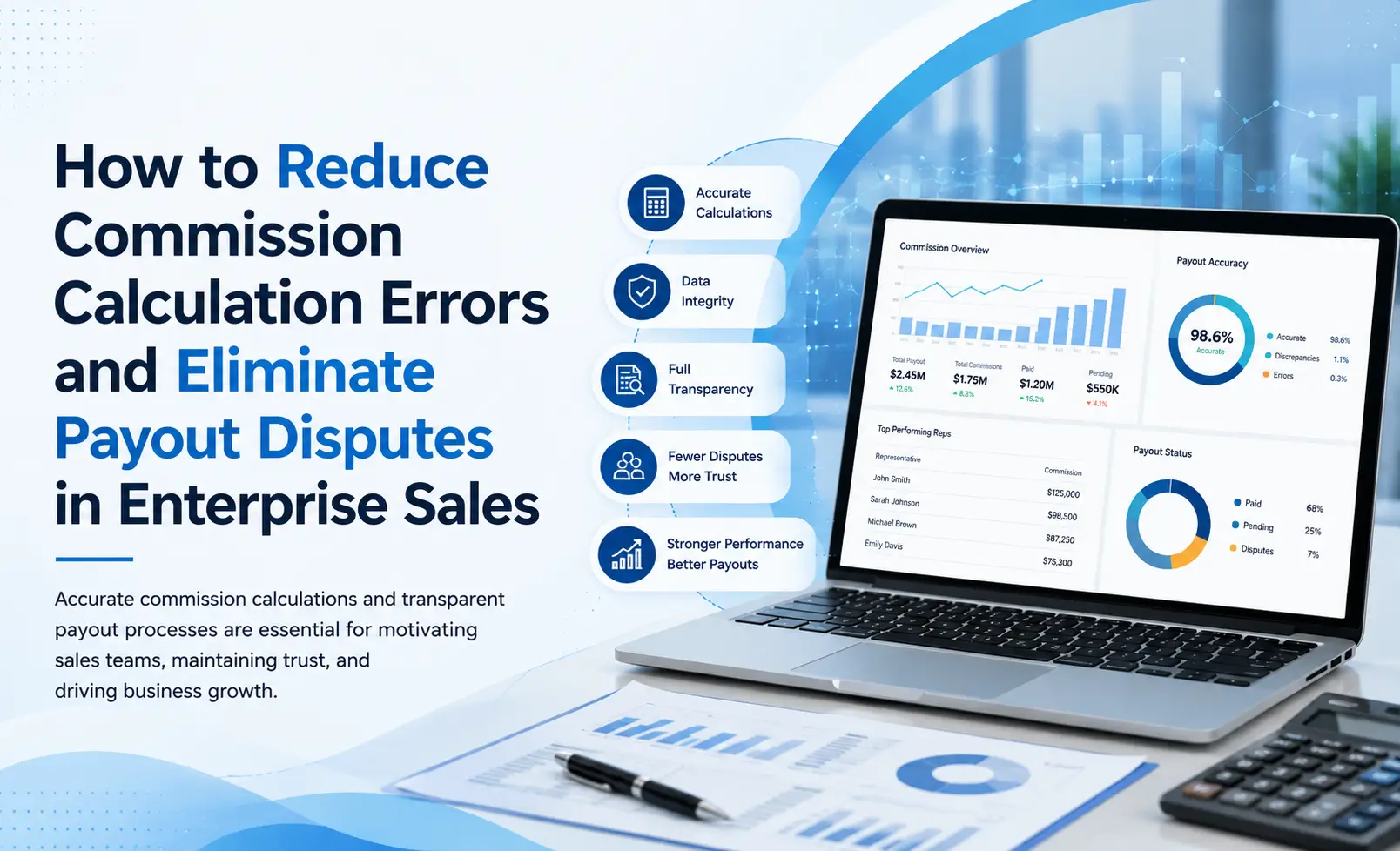
How to Reduce Commission Calculation Errors and Eliminate Payout Disputes in Enterprise Sales
- June 26, 2026
- No Comments
How to Reduce Commission Calculation Errors and Eliminate Payout Disputes in Enterprise Sales
Sales commission errors cost enterprises far more than the overpaid or underpaid amounts. According to research from the Alexander Group, companies spend an average of 2 to 5 percent of total sales compensation budget correcting calculation mistakes, processing disputes, and managing manual adjustments. On a $50 million commission spend, that is $1 to $2.5 million in avoidable operational cost every year.
Beyond the financial waste, commission errors create a morale problem that compounds over time. When sales reps cannot trust their payslip, they start shadow-tracking their own deals in spreadsheets, escalating disputes, and spending time on compensation administration rather than selling. Sales managers get pulled into reconciliation conversations instead of coaching. Finance closes books late because payroll is waiting on compensation sign-off.
This is a solvable problem. Organizations that implement structured incentive compensation management processes consistently reduce payout errors to near zero — not through heroic effort, but through architecture. Here is exactly how it works
What Causes Commission Calculation Errors in the First Place?
Before building the solution, it helps to understand why enterprise commission errors are so persistent. Most calculation errors trace back to one of five root causes — and in most organizations, more than one of them is operating simultaneously.
Spreadsheet-Based Commission Processing
Spreadsheets remain the most common commission calculation tool in mid-market enterprises — and also the most error-prone. A World at Work sales compensation survey found that 73 percent of organizations still use spreadsheets for some part of their compensation calculation process. Formulas break. Data gets overwritten. Version control fails. Manual lookups introduce transposition errors. And none of this is auditable at the rule level. When something goes wrong, finding where is a manual investigation, not a system query.
Data Source Disconnection
Commission calculations require data from multiple systems: closed deals from CRM, invoice data from ERP, headcount and quota assignments from HRIS. When these systems do not talk to each other in real time, finance teams manually consolidate data each month — introducing mapping errors, timing mismatches, and reconciliation gaps. A deal that closes in Salesforce on the last day of the quarter may not appear in the commission run if the CRM-to-ICM data sync runs weekly rather than daily. That one timing gap generates a dispute every single month.
Poorly Documented Compensation Plans
Ambiguous compensation plan language is a structural error generator. When the plan document says “revenue credit will be applied at quota attainment” without defining which revenue items are creditable, how splits are handled, or when the crediting date applies, different members of the comp team interpret it differently — producing inconsistent calculations even with identical source data. The calculation is not wrong. The plan is undefined.
Missing Audit Infrastructure
In organizations without proper ICM governance, commission disputes are resolved through email threads and manual overrides with no systematic audit trail. This means the same type of dispute gets resolved differently each time, precedent is invisible to new team members, and finance has no defensible record for compensation decisions if challenged by a sales rep or external auditor. The dispute gets closed but the root cause stays open.
Manual Override Culture
Once a team develops a habit of correcting calculation errors through manual overrides, the problem compounds. Each override is a data entry point that can introduce new errors, bypasses the automated calculation logic, and generates reconciliation debt that accumulates across cycles. Organizations that rely on overrides are not managing their commission process — they are managing their commission workarounds.
What Is the Real Cost of Commission Disputes?
Before investing in a solution, it helps to quantify the full operational cost — not just the payout errors themselves. The financial exposure goes well beyond incorrect payment amounts.
Cost Category | Estimated Impact |
Overpayment corrections | 1–3% of total commission spend per year |
Finance team dispute resolution | 5–15 hours per dispute cycle per person |
Sales productivity loss | 2–4 hours per month per rep on shadow tracking |
Sales manager escalation time | 3–8 hours per month on compensation admin |
Rep attrition from distrust | Replacement cost: 6–9 months of OTE per rep |
Delayed payroll close | 1–3 additional days per cycle for manual reconciliation |
The attrition line is the one most organizations undercount. When a high-performing sales rep leaves because they do not trust their compensation, the cost is not the payout error that triggered the dispute — it is the recruiting, onboarding, and ramp time required to replace someone who was already productive. That figure typically runs between six and nine months of on-target earnings.
How Do Companies Reduce Sales Commission Calculation Errors?
Organizations that successfully reduce commission errors implement a combination of process changes and platform investments. The architectural components that matter most are:
Automated Calculation Engines
The single highest-impact action is replacing manual spreadsheet calculation with a rules-based automated compensation engine. Platforms like SAP Commissions, Xactly, and Varicent calculate commissions from source transaction data based on explicitly configured compensation rules — removing human data manipulation from the calculation loop entirely.
Once the rules are correctly configured and validated, the calculation output is deterministic: the same inputs will always produce the same output. That makes disputes immediately identifiable as data disputes rather than calculation disputes — a much faster and less contentious conversation to resolve.
Real-Time CRM and ERP Integration
Commission errors caused by data timing and mapping issues are eliminated by establishing direct, automated integrations between the ICM platform and source systems. CRM data — deal values, close dates, product line, rep assignment, split percentages — should flow into the ICM engine on a defined schedule with transformation logic that handles all crediting rules. ERP invoice data should follow the same pattern. Manual data exports and imports should be entirely removed from the commission calculation workflow.
Plan Documentation and Rule Governance
Every compensation plan rule should be documented in plain language before it is configured in the platform, with explicit definitions for crediting rules, eligible transactions, split logic, quota attainment thresholds, and payment timing. This plan document becomes the authoritative source of truth that governs both the platform configuration and the dispute resolution process. When a dispute arises, the answer is in the document — not in someone’s memory of what was decided last quarter.
How Can Enterprises Build a Dispute-Free Commission Environment?
A dispute-free commission environment requires strong governance and transparent processes. While ICM platforms support these practices, organizations must establish the right workflows to minimize disputes.
1. Real-Time Earnings Visibility
Provide sales reps with dashboards showing commission accruals, quota progress, expected earnings, and deal-level breakdowns. Greater transparency reduces disputes caused by uncertainty.
2. Structured Dispute Submission
Replace email-based disputes with a standardized workflow in the ICM platform. Record submissions, responses, and decisions with a complete audit trail to ensure consistency.
3. Calculation Audit Trails
Ensure every commission payout is traceable to the underlying transaction, rule, and calculation. Detailed audit trails enable finance teams to resolve disputes quickly and accurately.
4. Monthly Reconciliation
Validate calculated payouts against quota attainment and CRM data before each commission run. Identifying discrepancies before payment helps prevent corrections, clawbacks, and unnecessary disputes.
What ICM Platform Features Reduce Payout Errors Most Effectively?
When evaluating ICM platforms specifically for error reduction, prioritize these capabilities:
- Rules-based calculation engine with no manual override capability at the data level
- Direct API integrations with your CRM (Salesforce, Microsoft Dynamics, SAP CRM) and ERP
- Transaction-level audit logging that records every calculation step
- Rep-facing real-time earnings dashboards updated on a defined schedule
- Structured dispute workflow with status tracking and resolution documentation
- Parallel calculation testing — ability to run new plan configurations against historical data before going live
- Alert and exception workflows that flag anomalous payouts for review before release
No single platform delivers all seven capabilities equally well — which is why platform selection should follow process design, not precede it. Understanding your specific calculation complexity, integration requirements, and governance gaps first leads to a better platform choice and a faster implementation.
How Long Does It Take to Eliminate Commission Errors After ICM Implementation?
Organizations that implement ICM platforms with proper integration and governance typically see error rates drop by 85 to 95 percent within the first three commission cycles. The remaining errors are almost always data issues from source systems — missing deal records, incorrect territory assignments, late invoice postings — rather than calculation errors within the ICM platform itself.
With mature data governance in place, those residual issues reduce further over the following two to three quarters. Most organizations reach a steady state where commission disputes are genuinely exceptional events rather than a recurring monthly exercise.
The timeline depends on how much of the problem is platform-related versus process-related. Organizations that implement the right platform on top of poorly documented compensation plans or unresolved data quality issues will see improvement — but not the full 85 to 95 percent reduction. The governance work and the platform work have to happen together.
Building a Sustainable Commission Process
If your commission process involves spreadsheets, manual overrides, or monthly dispute emails, the architecture is the problem — not your team. These are structural issues that well-intentioned people cannot fix through extra effort. They require a different approach to how commission data flows, how calculations are governed, and how reps access information about their own earnings.
The organizations that solve this problem consistently do three things: they automate the calculation engine, they integrate it directly with their CRM and ERP, and they build governance processes that give every stakeholder — reps, managers, finance, and leadership — visibility into how every payout was produced.
Ready to Simplify Your Commission Management?
eGlobal Infotech specializes in ICM implementation, integration, and compensation governance across SAP Commissions, Xactly, and Varicent. We offer a complimentary commission process assessment where our specialists map your current-state errors and identify exactly where the architecture needs to change. Get Started Today Email info@eglobalinfotech.com or visit eglobalinfotech.com to book yours.
FAQs
Higher than most teams expect. Finance, sales ops, and reps all need to adjust. The organizations that manage it best involve all three groups from requirements gathering — not just at go-live training.
Yes. ICM platforms integrate with your existing CRM and ERP — they read data from those systems and output payroll-ready commission figures. Your existing systems stay in place.
Run two to three parallel calculation cycles where both the legacy process and the new platform run simultaneously. Any discrepancy gets resolved before go-live, so the first live commission run is already validated.
A commission error is a wrong calculation. A commission dispute is a rep challenging a payout — which may or may not involve an actual error. Better earnings visibility reduces disputes even when calculations are already correct.