
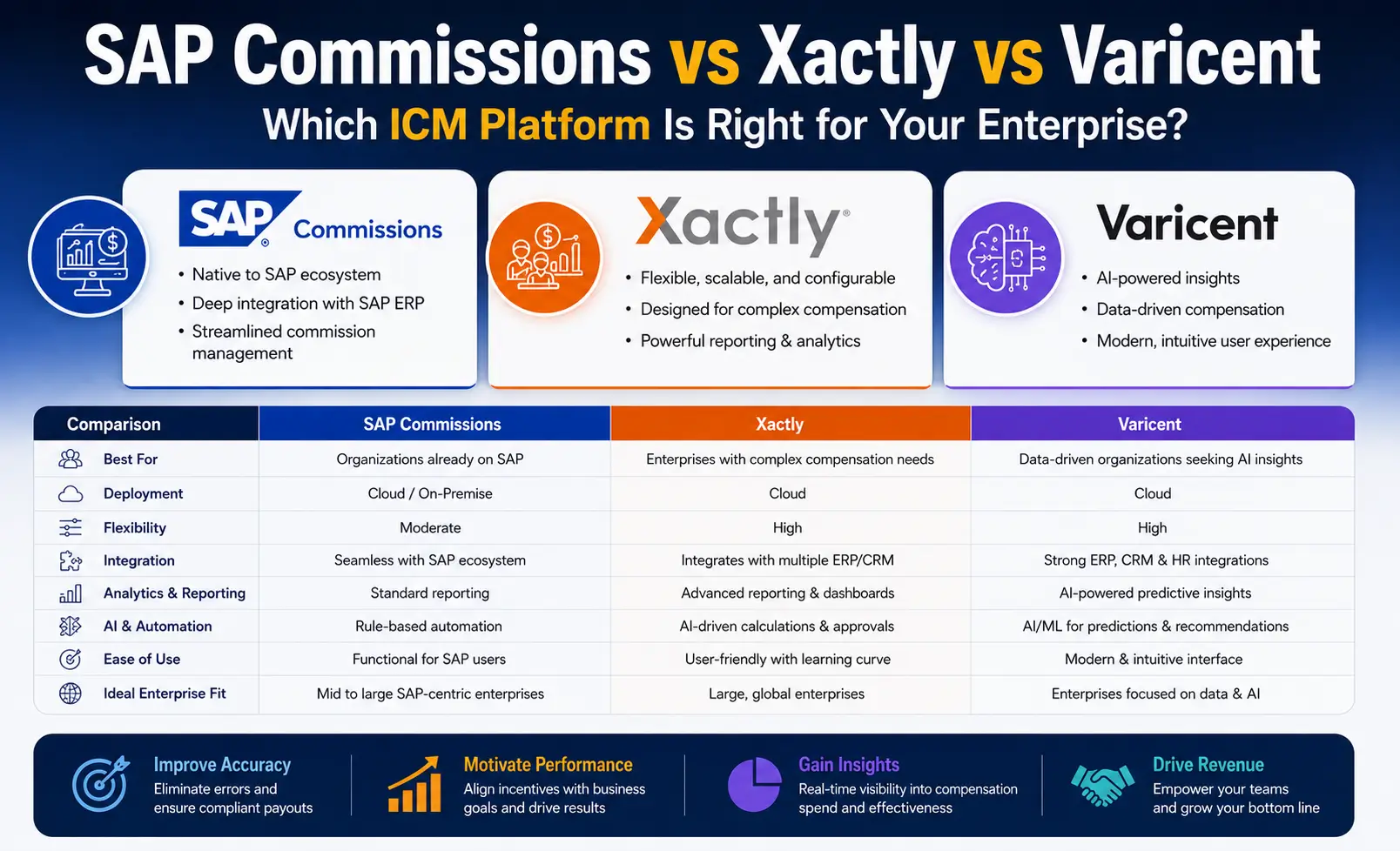
SAP Commissions vs Xactly vs Varicent Which ICM Platform Is Right for Your Enterprise?
- June 24, 2026
- No Comments
SAP Commissions vs Xactly vs Varicent Which ICM Platform Is Right for Your Enterprise?
Choosing an incentive compensation management platform is not a software decision — it is a structural decision about how your organization governs, calculates, and communicates sales pay. Get it wrong and you will be rebuilding within three years. Get it right and your commission process moves from a monthly liability into a competitive advantage.
The three platforms that dominate enterprise ICM evaluations are SAP Commissions (formerly CallidusCloud), Xactly Incent, and Varicent. Each has genuine strengths. Each has clear limitations. And none of them is automatically the right answer.
This guide breaks down exactly how they compare across the dimensions that matter most to enterprise buyers: platform architecture, integration depth, scalability, analytics capability, and total cost of ownership. If you are currently shortlisting ICM vendors, this is the analysis you need before your next demo.
What Should Enterprises Actually Evaluate in an ICM Platform?
Most ICM evaluations go wrong because buyers focus on feature lists rather than operational fit. Before comparing platforms, align your team on the four dimensions that genuinely determine long-term success:
- Calculation engine complexity: Can the platform handle your actual comp plan logic, including multi-tier structures, draw recoveries, clawbacks, splits, and non-standard crediting rules?
- Data integration architecture: How does the platform connect to your CRM, ERP, and HRIS — and how reliably does that data flow in real time?
- User experience for reps and managers: Will salespeople actually use the earnings dashboards, or will they keep sending dispute emails?
- Administration overhead: Can your internal team manage plan changes without deep technical involvement, or does every comp plan update require a consultant?
With those criteria established, here is how the three leading platforms stack up.
SAP Commissions: Best for Complex, High-Volume Enterprise Environments
What SAP Commissions Does Well
SAP Commissions (previously CallidusCloud) is the most capable platform in the market for organizations with genuinely complex compensation logic. If your comp plans involve multiple product lines with different crediting rules, territory overlaps, draw and recovery schedules, and multi-currency calculations across dozens of markets, SAP Commissions can handle it — and handle it at scale.
Its native integration with SAP ERP (S/4HANA, ECC) is a significant advantage for organizations already running SAP. Data flows between the ERP and the commissions engine without custom middleware, which reduces both implementation risk and ongoing maintenance burden.
SAP Commissions also provides strong audit capabilities. Every calculation is logged at the rule level, which makes finance sign-off and sales rep dispute resolution dramatically faster. For regulated industries — financial services, pharma, insurance — this auditability is not optional, and SAP Commissions delivers it out of the box.
Where SAP Commissions Has Limitations
The platform is not lightweight. Implementation timelines for complex environments typically run six to twelve months. The configuration layer is powerful but requires specialized expertise — organizations that attempt SAP Commissions implementations without certified SAP partners consistently encounter overruns. Administration overhead is also higher than Xactly or Varicent for mid-complexity plans.
Xactly Incent: Best for Mid-Market Speed and Salesforce-Native Organizations
What Xactly Does Well
Xactly Incent has the fastest time-to-value of the three platforms for organizations with standard to moderately complex compensation structures. Its user interface is widely regarded as the most intuitive in the market, which drives adoption among sales reps and reduces the volume of commission disputes that come from reps not understanding their payouts.
Xactly’s native Salesforce integration is class-leading. For organizations running Salesforce CRM, the data sync is tight and well-supported, and the rep-facing earnings widgets inside Salesforce are genuinely useful. Xactly also offers strong benchmarking data through its Xactly Insights database — allowing organizations to compare their comp plan structures against industry peers, which is valuable during plan redesign cycles.
Where Xactly Has Limitations
Xactly begins to show strain as compensation complexity increases. Organizations with more than 1,500 compensable payees or highly non-standard crediting logic often outgrow the platform’s native capabilities and require extensive customization that erodes the time-to-value advantage. Xactly is also primarily a cloud-native SaaS product, which is excellent for most buyers but limits configuration flexibility for enterprises with strict data sovereignty requirements.
Varicent: Best for Analytics-Heavy SPM and Enterprise-Grade Flexibility
What Varicent Does Well
Varicent — which acquired IBM’s Incentive Compensation Management product in 2019 — is the strongest platform for organizations that treat compensation as a strategic performance management tool rather than a payroll calculation exercise. Its analytics and modeling capabilities are more advanced than both SAP Commissions and Xactly. Finance and sales operations teams can run what-if scenarios across entire comp plan structures before changes go live, which is valuable during quota-setting cycles.
Varicent’s workflow engine is also more configurable than most buyers realize. Approval chains, exception handling, adjustment workflows, and dispute resolution processes can all be modeled inside the platform, reducing email-based back-and-forth between sales, finance, and HR.
Where Varicent Has Limitations
Varicent’s implementation complexity is comparable to SAP Commissions — it is not a platform for organizations that need rapid deployment. Pre-built integrations are less extensive than Xactly, meaning CRM and ERP connections often require more custom work. Support quality has been a consistent feedback item in enterprise user reviews.
Side-by-Side Platform Comparison
SAP Commissions | Xactly Incent | Varicent | |
Best Fit Org Size | Enterprise (1000+ reps) | Mid-market to Enterprise | Enterprise (500+ reps) |
Comp Plan Complexity | Very High | Low to Medium | High |
SAP CRM, SFDC, others | Salesforce-native (best) | Flexible, custom work needed | |
ERP Integration | SAP-native (best) | Moderate | Moderate |
Analytics Capability | Strong | Good (with Insights) | Best-in-class |
Time to Deploy | 6-12 months | 3-6 months | 5-10 months |
Admin Complexity | High | Low | Medium |
Audit / Compliance | Best-in-class | Good | Strong |
Which ICM Platform Should Your Enterprise Choose?
There is no universal answer, but there are clear decision rules:
Choose SAP Commissions if: you are already running SAP ERP, you have highly complex multi-tier comp plans, you operate in a regulated industry that requires iron-clad audit trails, or you are managing compensation for more than 2,000 sales payees.
Choose Xactly Incent if: Salesforce is your CRM backbone, you need faster time-to-value, your comp plans are standard to moderately complex, and broad user adoption matters more than deep technical configurability.
Choose Varicent if: your finance and RevOps teams want sophisticated plan modeling and what-if analytics, you are treating compensation as an active performance lever rather than a payroll output, and you have the implementation bandwidth for a more intensive deployment
What Does a Successful ICM Platform Selection Process Look Like?
Organizations that make the right ICM platform selection tend to follow a structured process: they map their current comp plan complexity before entering vendor demos, they involve sales operations and IT alongside sales leadership, and they evaluate integration architecture with their specific CRM and ERP stack before signing any contract.
Working with an implementation partner who is certified across all three platforms — rather than one who resells only one — gives you independent analysis rather than a sales pitch. eGlobal Infotech implements SAP Commissions, Xactly, and Varicent, which means our recommendation is based on what fits your environment, not our preferred vendor relationship.
Ready to evaluate ICM platforms for your enterprise? eGlobal Infotech implements SAP Commissions, Xactly, and Varicent — with no vendor bias. Contact us at info@eglobalinfotech.com or visit eglobalinfotech.com to schedule a platform assessment. |
FAQs
Some large organizations with distinct business units run different platforms — for example, SAP Commissions for the enterprise division and Xactly for a mid-market sales team. This is manageable with the right data architecture but adds integration and governance complexity. It is generally preferable to standardize on a single platform where possible.
For an enterprise with moderate to high plan complexity, expect six to twelve months from project kick-off to production go-live. Simpler environments can move faster. The biggest timeline driver is usually data readiness — how clean and structured your source data from CRM and ERP actually is.
SAP acquired CallidusCloud in 2018 and the products share lineage, which makes historical data migration more structured than migrating from a completely different platform. However, plan configuration does not migrate automatically — compensation rules need to be rebuilt and validated in the new environment. This is where experienced migration specialists prevent costly errors.